CLASSIFICATION PROCESS IN POE SYSTEMS
WHAT IS CLASSIFICATION AND WHY DO WE NEED IT?
In short, classification is a process of mutual identification of PSE and PD. It can be performed only after successful detection. During this process PSE is querying a PD in order to determine its power requirements while at the same time broadcasting its own type. Basically, PD provides information that allow a PSE to classify its power requirements, and PSE lets PD know its type. The mutual identification function is intended for use with advanced power management. Some "type 1" and "type 2" PoE systems ignore the results of the classification: many PSE may provide full power regardless of PD class.
Classification can be done in two ways: Physical Layer classification and Data Link Layer (DLL) classification (or a combination of both).
HOW DOES PHYSICAL LAYER CLASSIFICATION WORK?
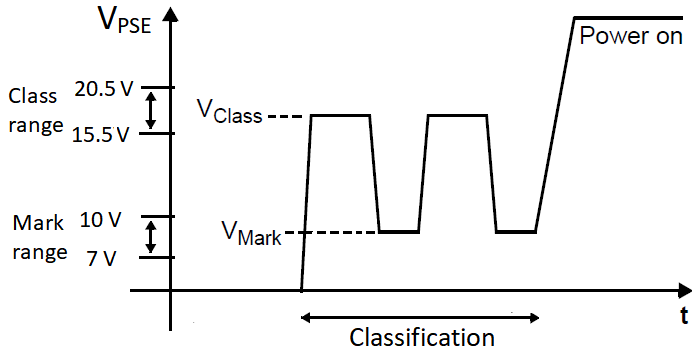
Physical Layer classification performed after a valid detection but before a PSE provides power to a PD. During this process PSE generates a series of short pulses called “class events” (in engineering jargon they are called "fingers"). A class event occurs when a PSE applies voltage between 15.5V and 20.5V for amount of time specified in a respective IEEE802.3 spec (around 30 ms). When a PD detects voltage in this range, within 5ms it should provide its valid class signature by drawing specific current I_class. This signature should then remain valid for the duraton of the classification pulse. By measuring I_class the PSE will know the PD requested class. The original IEEE802.3af standard defined requested classes 1 to 3. The subsequent IEEE802.3at standard defined classes 1 to 4. Accordingly, there are four levels of currents representing these four classes (see the Table below). If PD does not implement physical layer classification (does not draw any current during class event or draws less than 5mA) it is referred to as “class 0”. Most PSE by default will treat such PD as class 3, although some may treat it as class 4. After each class event the PSE should generate a so-called "mark event". A mark event happens when PSE lowers voltage to "mark range", which is 7 V to 10 V. Why does it needed? A mark event tells the PD that the previous class event has ended. This enables PD to measure class event duration and to count the number of class events. Particularly, PDs may determine the Type of the PSE and its power capabilities by measuring the duration of the first class event. Type 3 and Type 4 PSEs provide a long first class event (88-105 ms). This lets the PD know that the PSE is of Type 3 or Type 4.
| Measured I_class | Classification |
|---|---|
| 0-5 mA | Class 0 |
| 8-13 mA | Class 1 |
| 16-21 mA | Class 2 |
| 25-31 mA | Class 3 |
| 35-45 mA | Class 4 |
Note that the legacy IEEE802.3af specified slightly narrower ranges of class currents.
Now, what happens if a PSE measures current between two valid class signatures? In such a case, the PSE can assign either of these two classes to such a PD. If class current is >45 mA and <51 mA, PSE can treat it either as class 4 or invalid class.
CLASSES IN IEEE802.3bt
The latest IEEE standard introduced 8 classes of PD. However, instead of defining 8 different current levels, it uses a combination of two classes to represent the PD classes from 5 to 8. A single-signature PD compliant to IEEE802.3bt has to change its class current in the process of classification as shown in the following Table. For example, for request class 5 a PD has to respond with class 4 for the first two class events, and subsequently respond as class 0.
| Class Signature Provided by PD | |||||
|---|---|---|---|---|---|
| Requested class | Event 1 | Event 2 | Event 3 | Event 4 | Event 5 |
| Class 1 | 1 | 1 | 1 | - | - |
| Class 2 | 2 | 2 | 2 | - | - |
| Class 3 | 3 | 3 | 3 | - | - |
| Class 4 | 4 | 4 | 4 | - | - |
| Class 5 | 4 | 4 | 0 | 0 | - |
| Class 6 | 4 | 4 | 1 | 1 | - |
| Class 7 | 4 | 4 | 2 | 2 | 2 |
| Class 8 | 4 | 4 | 3 | 3 | 3 |
We see that single-signature PDs that request Classes 5 through 8 have to change class signature after first two pulses.
Here is how PDs technically manifest their class signature. Any PD controller normally has a pin dedicated to classification function: "class pin". When the PD chip detects voltage within classification range, it connects the class pin to some internal reference. As the result, the current starts flowing from class pin. A resistor connected to this pin determines the current drawn from it. Inside the chip there is also a current mirror. It can draw current from PoE line equals to the current drawn from the class pin. The PD controllers designed for IEEE802.3bt normally have two class pins, and accordingly two class resistors. After the second class events they can switch the current mirror from one class pin to the other, thus providing classification signatures 5 through 8.
